*** VISUALIZZAZIONE IN ANTEPRIMA ***
background

Built on Safety. Driven by Excellence.

With decades of experience in professional pilot training, Aviomar Flight Academy offers internationally recognized programs designed for both aspiring pilots and experienced flight crews. Since 1982.

Start your journey

Our Courses and Programmes

At Aviomar, an EASA certified ATO (IT.ATO.0003), you can undertake training for Private Pilot, Commercial Pilot, and Frozen ATPL licences (both Integrated and Modular), as well as the Instrument Rating (IR). We also offer Instructor courses (FI - IRI - CRI - SFI - TRI - MCCI) alongside numerous other ratings.

Resources and Insights

Whether you are already a pilot, aspire to become one, or are simply an aviation enthusiast, this section offers a wide range of services and insights tailored specifically for you. Discover all the solutions and information you need to achieve your goals or to further your passion for aviation.

AVIOMAR GRADUATES NOW FLY FOR THE WORLD'S LEADING AIRLINES

ryanair
cathay-pacific
lufthansa
airfrance
turkish-airlines
emirates
easyjet
norwegian
quatar
sas
vueling
swiss
tap
singapore
british-airways
alitalia
air-hongkong
air-baltic
areoflot
aegean

Blog & News

Discover the latest news from the world of aviation and stay up to date with our training courses and opportunities: your journey to the skies begins here!

FAQ - Frequently Asked Questions

Discover everything about the path to becoming an airline pilot: training and licenses, costs and financing options, choosing the right school, salaries and career prospects, daily life in the cockpit. A complete guide with answers to the most common questions to help you turn your passion into a profession.

One of the most common questions concerns secondary education: "Which high school should I choose to become a pilot?". The answer is that no specific stream is required. Any secondary school diploma (High School Diploma) is valid for accessing flight training.

The crucial choice occurs after the diploma: enrolling in a certified Flight School, officially recognised as an ATO (Approved Training Organisation). This certification, issued in Italy by ENAC in accordance with rigorous European EASA regulations, is the only guarantee that the training received meets the highest safety and quality standards required by airlines.

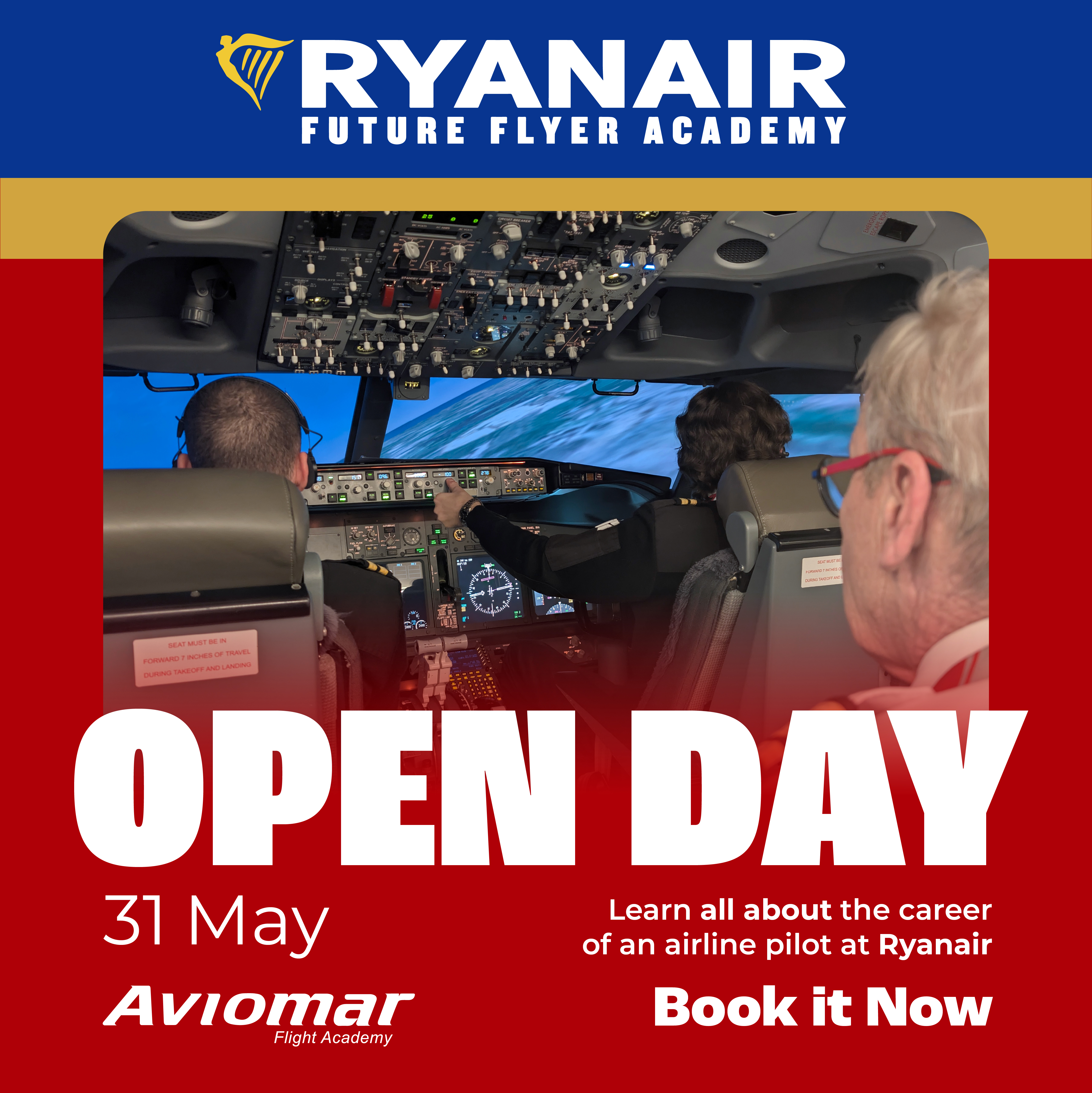
Aviomar is an ENAC-certified ATO, approved by EASA with certificate number IT.ATO.0003. With over 40 years of activity, our history is the most solid guarantee of our reliability and competence. We operate across three strategic locations in Italy: our historic base at Roma Urbe Airport for initial training, the advanced simulator training centre in Monterotondo, and our new hub in Parma, home to the Ryanair Future Flyer Academy. This structure allows us to offer complete and diversified training, from the first flight to complex jet training. Choosing Aviomar means investing in guaranteed quality: certified by aviation authorities and chosen by strategic partners like Ryanair.

Further Reading:

The path to becoming a professional pilot is marked by a series of licences with increasing privileges. The three fundamental ones are:

  • PPL (Private Pilot Licence): This is the basic licence and the first milestone for every pilot. It enables you to fly for personal and recreational purposes, but it does not permit you to be remunerated for flying.
  • CPL (Commercial Pilot Licence): This marks the entry into the professional world. With this licence, you can legally be paid to fly, opening doors to careers such as Flight Instructor or aerial work pilot.
  • ATPL (Airline Transport Pilot Licence): This represents the highest level of certification. Initially, upon completion of training, one obtains a "Frozen ATPL". This means having passed all 14 ATPL theoretical exams and holding a CPL with the necessary ratings. This qualification allows you to be hired as a First Officer in an airline. The ATPL becomes "unfrozen" (Full ATPL) only after accruing 1,500 flight hours.

At Aviomar, we offer structured training pathways to guide students through this exact progression, from the first PPL licence to the Frozen ATPL, ready for airline selection processes. Whether you choose our Integrated Course, designed for full immersion, or a more flexible Modular Course, our goal remains the same: to provide you not only with the licences but, above all, with the skills and preparation necessary to succeed in airline assessments and begin a successful career.

Further Reading:

Pilot training always consists of two fundamental components: a theoretical phase on the ground (Ground School), where the 13 EASA subjects are studied, and a practical phase in flight. The duration depends on the chosen mode:

  • Integrated Course: An intensive, full-time programme that is completed, on average, in 24–36 months.
  • Modular Course: Offers greater flexibility and allows you to manage timing based on your own needs, usually requiring a longer period.

At Aviomar, we have optimised this structure over 40 years of experience. Theoretical training takes place in our modern classrooms, while the practical part is supported by one of the largest fleets in Italy, comprising 23 aircraft and 6 advanced flight simulators. Our unique infrastructure, distributed over three locations, is designed to follow the student's progression: from the Rome Urbe operational base for initial training, to our Monterotondo centre specialising in jet training with 3 Full Motion simulators, up to the Parma hub, the heart of our partnership with the Ryanair Future Flyer Academy. This organisation ensures a fluid and professional transition from basic flying to complex line operations.

Further Reading:

The choice between an Integrated and a Modular path is one of the most strategic decisions for an aspiring pilot.

  • Integrated Pathway: This is an intensive, full-time, uninterrupted training programme that takes a student from zero experience to a Frozen ATPL in approximately 24–36 months. It is the quickest route to enter the workforce and is often preferred by airlines for its continuity and structure.
  • Modular Pathway: Offers a "step-by-step" approach. Each licence (PPL, CPL, etc.) and rating is obtained separately. This path guarantees maximum flexibility, allowing you to study and fly at your own pace and, potentially, to work simultaneously.

The choice depends entirely on your objective and availability. To help you decide which path suits you best, we invite you to read our in-depth blog post:

This is one of the most critical questions, and the answer is less obvious than it seems. Although the Modular path appears cheaper because it allows payments to be spread out, the total final cost can be very similar to that of an Integrated course.

The risk of the Modular route lies in costs that are not always evident at the start: the hour building phase, exam fees for each individual module, travel and accommodation costs if different schools are chosen for various ratings, and potential downtime between modules which can prolong training.

At Aviomar, we approach this topic with maximum transparency for both pathways. Our Integrated Course is structured with a clear price that includes all training phases, offering a complete view of the investment from the start, with no surprises. For those choosing the Modular Pathway, we offer the unique advantage of being able to complete all modules within our organisation, using our fleet and locations. This not only guarantees a constant quality standard but eliminates the costs and logistical complications associated with moving between different schools, optimising both time and total investment.

Our advice is not to evaluate only the price of a single module, but the overall investment. Contact us for a detailed and transparent quote for both options, so you can make a truly informed choice suited to your needs.

Further Reading:

The theoretical path to obtain the ATPL licence is one of the most intense and demanding phases of training. All candidates in Europe must demonstrate solid knowledge of 13 fundamental subjects, defined by EASA (European Union Aviation Safety Agency), by passing an examination for each. This study programme, known as "Ground School", covers every aspect of flight:

  • Air Law
  • Aircraft General Knowledge (Airframe/Systems/Powerplant)
  • Instrumentation
  • Mass & Balance
  • Performance
  • Flight Planning & Monitoring
  • Human Performance & Limitations
  • Meteorology
  • General Navigation
  • Radio Navigation
  • Operational Procedures
  • Principles of Flight
  • Communications (VFR & IFR)

At Aviomar, we believe that excellent theoretical preparation is the foundation for becoming a competent and safe pilot. For this reason, our Ground School, held in the modern classrooms of our Rome and Parma locations, is not limited to simple rote learning for exams. Our instructors, many of whom are airline pilots with thousands of hours of experience, transmit practical knowledge that goes beyond textbooks, teaching students to think like true professionals from day one.

Further Reading:

Choosing to become a pilot goes far beyond a simple passion for flight; it is a career decision that offers a unique combination of benefits. Key motivations include:

  • Global Career Opportunities: The sector is constantly growing and requires well-trained pilots, offering solid employment prospects.
  • A Dynamic Lifestyle: Forget the routine. A pilot's life consists of flexible rosters, travel, and the chance to see the world from a unique perspective.
  • Professional and Personal Growth: It is a profession that requires continuous learning, developing leadership, decision-making, and stress management skills that are unparalleled.
  • Responsibility and Prestige: Being responsible for the safety of hundreds of passengers and a complex aircraft is a role of great prestige and satisfaction.

At Aviomar, we deeply understand these motivations. That is why our training is not limited to teaching how to fly. Our goal is to form complete professionals, ready to embrace every aspect of this career. We prepare our students to become the leaders and decision-makers that airlines seek, providing them not only with technical skills but also with the mindset and resilience necessary to excel in this dynamic and rewarding environment.

Further Reading:

The first official step for anyone aspiring to a professional career is to obtain a Class 1 Medical Certificate. This examination, conducted in Italy at an IML (Italian Air Force Institute of Legal Medicine) or an AeMC (EASA Aeromedical Centre), is the true "green light" authorising you to embark on the path.

Understanding all the necessary steps, from initial requirements to the first hours of flight, is fundamental for planning your future. For this reason, we have prepared a complete guide. For a detailed view of the entire path, we invite you to read our blog post: How to Become an Airline Pilot: The Aviomar Guide for Future Captains.

Further Reading:

Pilots do not simply speak English; they use a specific and highly standardised language worldwide, known as Aviation Phraseology. This code, based on English, uses a restricted vocabulary, precise syntax, and the ICAO phonetic alphabet (Alpha, Bravo, Charlie...) for a single, fundamental reason: to eliminate any possible ambiguity and guarantee clear, concise, and safe communication, especially in high-pressure situations. It is a true technical language, essential for safety.

At Aviomar, learning phraseology is not a separate course, but a competence integrated into every phase of training from day one. Our students begin practising it in "VFR & IFR Communications" lessons, consolidate it in our 8 flight simulators, and make it automatic during real flight missions with our instructors. This immersive approach ensures that our graduates do not just know the language, but "think" in it, preparing them to operate safely in any airspace in the world and to integrate perfectly into the operations of international airlines like our partner Ryanair.

Further Reading:

It is essential to be honest: becoming an airline pilot is a demanding and rigorous path that requires total commitment. The complexity of the 13 theoretical subjects and the rigour of practical training are real challenges, designed to form professionals capable of managing complex situations with maximum safety.

At Aviomar, we are aware of the commitment required. This is why, in 40 years of history, we have built a structured support environment to help our students overcome every obstacle. Our method is based not only on teaching but on constant mentoring. Every student is followed by expert instructors, has access to a modern fleet and advanced simulators to consolidate practical skills, and can count on a dedicated team ready to provide educational and operational support. The demanding nature of the path is the reason why choosing a solid, experienced, and well-equipped school like ours makes the crucial difference between merely trying and succeeding.

Further Reading:

Becoming a Captain is the pinnacle of a pilot's career and represents a professional growth path that lasts years, well beyond obtaining the initial licence. The standard path develops through four key phases:

  1. Obtaining the "Frozen" ATPL: This is the starting point. Theoretical and practical training is completed at a certified flight school.
  2. Being hired as a First Officer: With a Frozen ATPL, you access airline selections to start flying as a co-pilot.
  3. Accumulating experience and flight hours: Working as a First Officer, you accumulate thousands of flight hours (usually between 3,000 and 5,000), refining technical and management skills.
  4. Passing the Command Course (Upgrade Course): Once the necessary seniority and experience are reached, the airline proposes an "upgrade" course for the role transition, which includes a practical and leadership examination.

Every step of this career depends on the solidity of initial preparation. At Aviomar, every course—from the Integrated ATPL to the Ryanair Future Flyer Academy programme—is designed not just to get you a licence, but to train future Captains. We provide the technical skills, professional mindset (airmanship), and standard procedures that airlines look for in their First Officers and future leaders. Furthermore, thanks to our advanced training division, we support pilots in subsequent phases with MCC (Multi-Crew Cooperation) and Type Rating courses, which are fundamental for the transition from school to the line. Our mission is to build the foundations of your entire career, right up to the left-hand seat.

Further Reading:

Absolutely, yes. There are no regulatory age limits to start training, and the life experience and maturity of a candidate in their 30s or 40s are often seen as added value. However, it is important to be realistic about the challenges: the financial investment requires more careful planning, and you enter a seniority-based career system starting from a different position compared to a twenty-year-old.

Precisely for this reason, the choice of training path becomes even more strategic. At Aviomar, thanks to our experience of over 40 years, we have guided pilots of all ages to success. For a candidate who already has an established career or a family, our Modular Course represents the ideal solution: it offers maximum flexibility to reconcile study, work, and private life, allowing you to reach the goal without overturning your daily routine. For those who can and want to dedicate themselves completely to the dream, our Integrated Course remains an excellent option.

The key to success is realistic planning and the support of an experienced school. Contact our admissions team: we will be happy to discuss a personalised path based on your experience and goals, demonstrating that it is never too late to take off.

Further Reading:

The investment to become an airline pilot is significant, and the price range is wide. Generally, in Europe, the costs for an ATPL course range between €70,000 and €120,000. This variation is not accidental; it reflects substantial differences in training quality, fleet modernity, the number and level of flight simulators, infrastructure, and, above all, partnerships with airlines, which can directly influence career opportunities.

At Aviomar, we believe in maximum transparency. The cost of our training paths, such as the Integrated ATPL or the Ryanair Future Flyer Academy programme, is a direct reflection of the high value we offer: a fleet of 23 aircraft, 6 advanced simulators, three operational bases, and a strategic partnership with Ryanair. We do not just sell a course, but a structured career path. For this reason, we always invite aspiring pilots not to evaluate solely the final price, but to understand what is included.

To receive a detailed and transparent offer, with no hidden costs, and to fully understand the investment necessary for your future career, we invite you to contact our admissions team.

Further Reading:

If your dream is to fly an aeroplane out of passion, without the goal of an airline career, the path is much more accessible. The Private Pilot Licence (PPL), which enables recreational flying throughout Europe, has a significantly lower cost than professional paths, averaging between €10,000 and €12,000.

At Aviomar, we offer a PPL course that combines solid theoretical preparation (120 hours of lessons in our classrooms at Rome Urbe) with a complete practical experience of 45 flight hours. Our course is designed not only for those seeking the pleasure of flight but also as the first, fundamental building block for those who might wish to undertake a Modular path towards a professional career in the future. You will have the chance to fly on our modern and diverse fleet, learning the basics of flight in a professional and safe environment.

Further Reading:

It is true that some schools, especially in Eastern or Southern Europe, may attract students with apparently lower list prices. However, a decision based solely on price can prove to be a short-sighted choice and, in the long term, more expensive. The correct question is not "where does it cost less?", but "where do I get the best value for my investment?".

The value of training at Aviomar lies in concrete advantages often missing in low-cost offers: a fleet of 23 aircraft, 6 modern simulators, an in-house maintenance centre, and a strategic partnership like the one with Ryanair. Choosing to train in Italy with us also offers a non-negligible climatic advantage: favourable weather conditions for most of the year ensure continuity in practical training, minimising delays and wasted time. Added to this is the elimination of hidden costs related to travel, accommodation abroad, and complex licence conversions. It means investing in a clear path, supported by over 40 years of experience, which prioritises quality and real career opportunities.

Further Reading:

Facing the investment to become a pilot is a challenge, but there are several strategies to make it more manageable. The main ones are:

  • Bank Loans: Many schools have agreements with credit institutions to offer specific financing for pilot training.
  • Modular Pathway: Choosing a modular route allows you to spread the expense over time, tackling the cost of one licence at a time.
  • Cadet Programmes: These are the most coveted routes, where airlines partially or totally sponsor training. However, they are extremely competitive and rare.

At Aviomar, we have worked to make these strategies concrete. We have a solid agreement with BNL Gruppo BNP Paribas, which offers our students the "Futuriamo" loan, designed specifically to support the investment of the flight course. Furthermore, our offer of a complete Modular path, carried out entirely at our locations, represents a valid option for those needing financial flexibility. Finally, our partnership with the Ryanair Future Flyer Academy offers a privileged path towards one of the largest European airlines. Our goal is to offer concrete solutions to help you finance your dream.

Further Reading:

A "Type Rating" is the specific qualification that certifies a pilot to operate a specific model of complex aircraft (e.g., Boeing 737 or Airbus A320). Since every airliner has a unique cockpit, systems, and flight characteristics, a generic licence is not sufficient. The Type Rating is, therefore, an intensive theoretical and practical course, conducted almost entirely on Full Motion simulators, to learn all normal and emergency procedures for that specific aircraft.

It represents the final step before starting work, and its cost, typically between €25,000 and €40,000, is normally not included in the price of the ATPL course. The policy on who must bear this expense varies: some airlines finance it entirely, others require the pilot to pay, or finance it via a "bond" with deductions from the salary.

At Aviomar, we do not limit ourselves to preparing you for the ATPL licence; we also accompany you in this crucial phase. Thanks to our advanced training centre in Monterotondo, equipped with Full Motion flight simulators, we are one of the few academies in Italy to offer Type Rating courses directly in our facility. Our Boeing 737 simulator, a fundamental asset also by virtue of our partnership with Ryanair, allows our cadets and external pilots to complete the rating for one of the most common aircraft in the world. This makes Aviomar a partner for your entire career, from the first hour of flight to the line.

Further Reading:

The right question is not "which is the absolute best?", but "which is the best for me?". Every aspiring pilot has different goals: a professional path towards airlines, modular training while working, budget, logistics, language, post-course support. True excellence is the school that takes you reliably and transparently from where you are today to the cockpit where you want to be tomorrow. When evaluating a school, always check: EASA/ENAC approvals (ATO), quality of theoretical training, real availability of the fleet, certified simulators, operational experience of instructors, completion rates, and—a key factor often overlooked—real opportunities for entry into the job market (partnerships with airlines, mentoring, selection support).

At Aviomar, for over 40 years, we have built our reputation on these pillars. Our certification IT.ATO.0003, the fleet of 23 aircraft, 6 simulators, and three operational bases are our guarantee of quality. But what distinguishes us is our career-oriented ecosystem: our internal maintenance division ensures fleet efficiency, while strategic partnerships like the one with the Ryanair Future Flyer Academy provide our students with a defined and privileged path to the cockpit of one of Europe's major airlines. Choosing a school means choosing a partner for your career: our history and our results speak for us.

Further Reading:

The European flight training market is a highly competitive ecosystem, with large academies holding consolidated partnerships with major airlines. In this international scenario, how is an Italian school positioned? The answer lies in the ability to offer a path that not only respects the highest EASA standards but also provides direct and privileged access to the European labour market.

At Aviomar, we have built our international reputation on this principle. A solid strategic partnership with Ryanair, the number 1 airline in Europe, through the Ryanair Future Flyer Academy programme. This does not just make us one of the main schools in Italy, but a European-level training partner, chosen by a major carrier for the quality and reliability of our training. Choosing Aviomar means accessing an international career path, starting from an Italian centre of excellence.

Further Reading:

No, a university degree is not required to become an airline pilot. The fundamental requirement, mandated by European EASA regulations, is a Secondary School Diploma (High School Diploma).

Further Reading:

The remuneration of an airline pilot in Italy varies significantly based on experience, the airline, and the role held. Generally, a First Officer at the beginning of their career can expect a net monthly salary between €1,800 and €3,000, especially in low-cost contexts. With experience and promotion to the role of Captain at a flag carrier or a major airline, remuneration can exceed €10,000–12,000 net per month.

These economic milestones are the arrival point of a career built on solid foundations. The quality of initial training is the factor that most influences the speed of progression and access to airlines offering the best opportunities. At Aviomar, we prepare our students not only to obtain a licence but to be competitive in the job market from day one. Programmes like our Ryanair Future Flyer Academy partnership are designed specifically to place our graduates in a clear career path, with defined economic progression, within one of the largest European airlines. Our training does not stop at the minimum required but aims to provide skills that allow our pilots to stand out and accelerate their professional and salary growth.

Further Reading:

A Ryanair pilot's salary is competitive and varies based on seniority and operational base. Indicatively, a First Officer with one year of experience based in Italy can earn approximately €4,500–5,500 net per month, while a Captain can exceed €10,000 gross monthly.

These numbers, rather than being simple data, represent a concrete goal for our students. Thanks to our strategic partnership, the Ryanair Future Flyer Academy programme offered at Aviomar is not just a course, but a direct and privileged path to access these positions. We train our cadets exactly according to the standards required by Ryanair, preparing them to enter one of the largest European airlines with a well-defined career and earnings perspective.

Further Reading:

Generally, easyJet offers slightly higher remuneration. An experienced Captain in the UK can exceed £150,000 gross per year.

24. How much does an Emirates pilot earn?

Emirates is among the most remunerative airlines in the world, thanks to competitive compensation packages and the advantage of tax-free salaries in Dubai. A First Officer can start from approximately $100,000 per year, while an experienced Captain can reach a total package, including accommodation allowance, of approximately $16,000 net per month.

Reaching these top-tier airlines requires impeccable training recognised internationally. It is the type of high-profile preparation we provide at Aviomar, where every aspect of training is designed to create pilots ready to compete in the global market.

Further Reading:

Emirates is among the most remunerative airlines in the world, thanks to competitive compensation packages and the advantage of tax-free salaries in Dubai. A First Officer can start from approximately $100,000 per year, while an experienced Captain can reach a total package, including accommodation allowance, of approximately $16,000 net per month.

Reaching these top-tier airlines requires impeccable training recognised internationally. It is the type of high-profile preparation we provide at Aviomar, where every aspect of training is designed to create pilots ready to compete in the global market.

Further Reading:

Variability is high in this sector too. One can start from approximately €26,000 per year for a First Officer on light aircraft, up to exceeding €100,000–150,000 for an experienced Captain on intercontinental jets.

Further Reading:

A flight instructor generally earns less than an airline pilot. In Italy, the salary ranges between €1,500 and €4,500 per month. Many undertake this career to accumulate the flight hours necessary to access airlines.

Further Reading:

Generally, the most remunerative airlines are those in the Middle East (such as Emirates and Qatar Airways), thanks to tax-free salaries and generous benefits, and large US cargo airlines (such as FedEx and UPS).

Further Reading:

To join Emirates, it is necessary to pass a very rigorous selection process. One can access it through their coveted cadet programmes (for those starting from scratch) or as a "Direct Entry Pilot" if one already holds a licence and a significant number of flight hours on airliners.

Further Reading:

A pilot operating on short and medium-haul routes, as is typical for most flights in Europe, usually performs 2 to 4 flights (or "sectors") in a single working day. This intense routine requires excellent preparation in time management, procedures, and stress management.

At Aviomar, we prepare our students precisely for this operational reality. Our programmes, and in particular the Ryanair Future Flyer Academy, are focused on training according to the standards of airlines operating on this model, ensuring that our graduates are ready to face the rhythms of line flying immediately.

Further Reading:

A pilot's life is regulated by very precise regulations (EASA FTL - Flight Time Limitations) to manage fatigue and guarantee maximum safety. The main limits are:

  • 100 flight hours in 28 consecutive days.
  • 900 flight hours per calendar year.
  • 1,000 flight hours in 12 consecutive months.

For an airline pilot, this translates into an operational average of approximately 70–85 real flight hours per month. It is important to note that "duty time", which also includes pre- and post-flight ground activities, is much longer. EASA regulations also guarantee minimum rest periods, such as at least 36 consecutive hours, including two local nights, every 7 days, to ensure adequate psychophysical recovery.

Further Reading:

Contrary to the widespread idea that the autopilot does all the work, the cruise phase is a moment of intense managerial and supervisory activity. "Engaging the autopilot" does not mean losing interest in the flight, but shifting from manual control to managerial control. Main tasks include:

  • System Monitoring: Pilots constantly monitor dozens of parameters: navigation, cabin pressurisation, fuel consumption, and the functioning of engines and electrical/hydraulic systems.
  • Weather Analysis: Weather conditions along the route are analysed to anticipate and, if possible, avoid areas of turbulence or storms, ensuring a more comfortable and safe flight.
  • Communications: Constant radio contact is maintained with various Air Traffic Control (ATC) units along the route, receiving instructions and reporting position and status.
  • Strategic Planning: Pilots begin planning subsequent flight phases, such as descent and approach, and thinking about the return leg or the next flight.

At Aviomar, training is designed to prepare for this managerial role. In our advanced simulators, such as the Boeing 737 and Airbus A320, students learn not just to fly, but to manage the aircraft as a complex system. Training focuses on developing decision making and situational awareness, fundamental skills for an airline pilot who, during cruise, is first and foremost a manager at high altitude.

Further Reading:

Rest management is one of the pillars of aviation safety, regulated by strict European regulations (EASA FTL) to prevent fatigue-related risks. It is not just about holidays, but a complex system balancing service and recovery.

  • Days Off: A pilot is entitled to a certain number of days off per month, generally varying between 12 and 18. Their distribution, however, is not like an office job. Rosters are often grouped in blocks (e.g., 5 days of work followed by 4 of rest), which allows for longer and more consistent breaks.
  • Minimum Rest Periods: After each duty period, a minimum rest period is guaranteed for immediate recovery. This period is calculated based on the duration and type of duty just concluded.
  • Annual Leave: Contractual holidays usually hover around 25–30 days per year. Their scheduling depends on seniority: more "senior" pilots have priority in choosing periods, while younger ones have less flexibility.

Understanding this balance is fundamental. At Aviomar, training includes a strong emphasis on discipline and the management of one's psychophysical state, preparing future pilots not only to respect regulations but to understand the importance of rest to always maintain maximum standards of performance and safety.

Further Reading:

An airline pilot at the end of their career can accumulate between 15,000 and 20,000 total flight hours. This figure, more than a precise statistical calculation, is a realistic estimate based on regulatory limits and the average duration of a career. Considering the EASA limit of approximately 900 flight hours per year, a pilot flying constantly for 30–35 years can achieve a logbook of exceptional experience. To give a concrete idea of what 20,000 hours means, it equates to spending two years and three months of uninterrupted time in the air. It is an immense wealth of experience that defines the pinnacle of aviation professionalism.

Further Reading:

AVIOMAR: EXCELLENCE IN TRAINING WITH THE WORLD’S LEADING PARTNERS

cessna
piper
midcontinent
midcontinent
cats
alsim
vrpilot
flypeople
mps
mps
mps

REQUEST INFORMATION

Fill out the form below. Our dedicated Customer Support Staff will assist you with any questions or concerns regarding your training.

Sending...
Please wait while we process your request